The Complete Home Loan Kit: FHA, VA, USDA and Conventional
3 printable workbooks (28 chapters) for US home buyers about to apply or holding a Loan Estimate: $49, one payment, instant online access, printable or saved as a PDF.
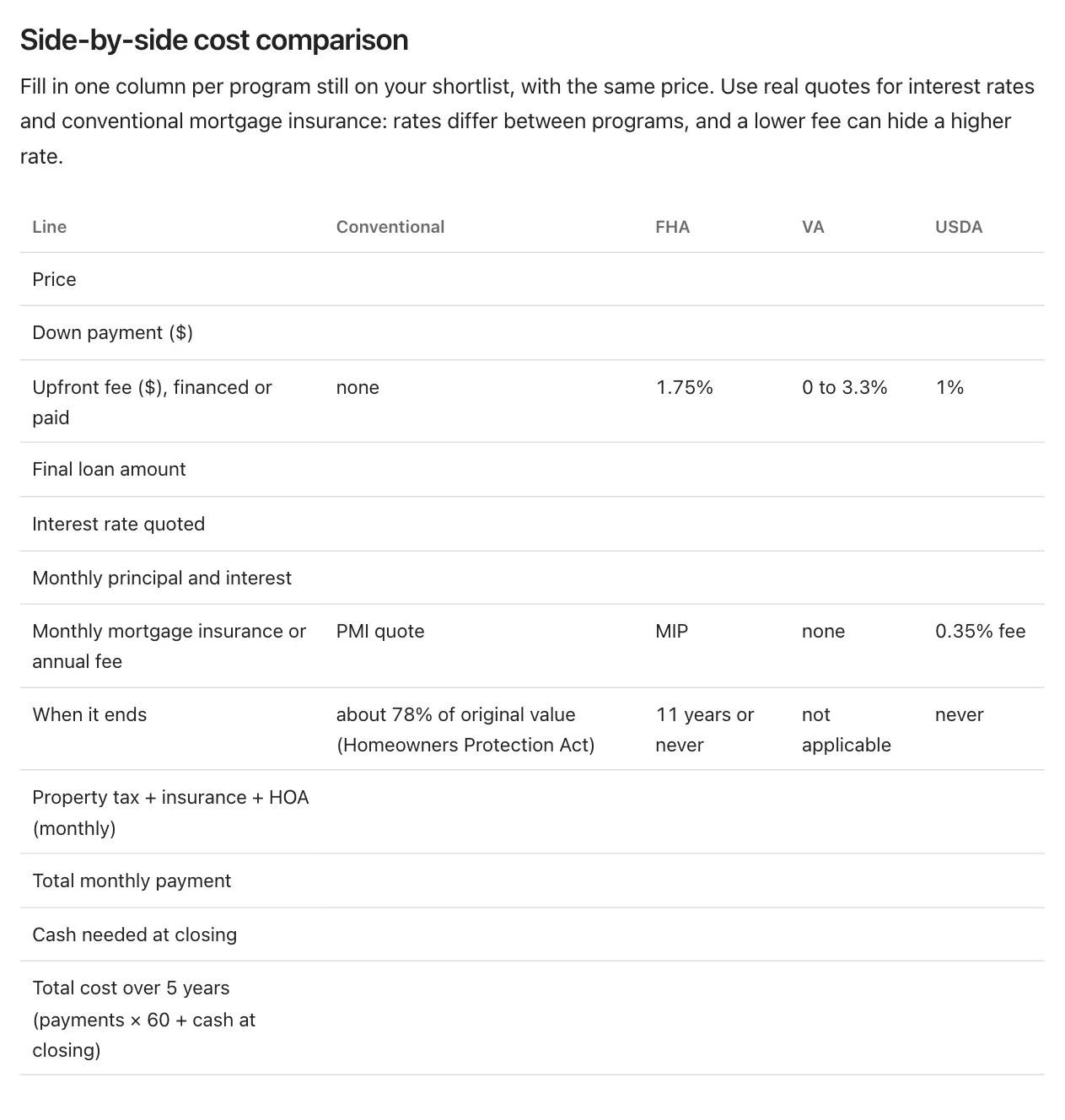
Shown: a real page, the side-by-side cost comparison of FHA, VA, USDA and conventional.
The FHA, VA and USDA workbook is sold only in this kit.
$49
$49 is the total, nothing added at checkout. 72 worksheets and reference tables, 112 checklist items, about 15,000 words.
Guaranteed as described, or refunded in full, and the wrong title switched within 7 days. Refund policy
Secure checkout by Stripe (card or Apple Pay). Refund policy
Questions: mail@noreply.claude-loan.com
Inside the kit:
- FHA, VA and USDA Loan Program Workbook (8 chapters, only in this kit): which one you qualify for, its fees, one cost sheet.
- Conventional Loan Qualification Workbook (10 chapters): 2026 limit, income, debt-to-income, cash to close, PMI.
- Mortgage Shopping & Closing Workbook (10 chapters): TRID deadlines, Loan Estimates compared, wire-fraud checks.
- 3printable workbooks
- 28chapters
- 112checklist items
- 72worksheets and tables
Checked before every release
Every rule is cited by section to an official source you can open (how titles are checked, corrections)
- 68automated testsrun at every release: prices, links, pages and data checked before publication.
- 15official sources linkedevery rule quoted with its section (HUD, CFPB, USDA) so you can check it.
- November 7, 2026editiondate of the current edition; rules and annual limits are updated when they change, and corrections are dated.
Built from the rules and data of HUD, CFPB, USDA, VA, FEMA, Fannie Mae.
Pick the loan program you really qualify for, price it to the dollar and close without a missed deadline: three printable workbooks, one kit.
What these costs run in 2026
The lines this kit puts on paper are the expensive ones. Official figures, read on November 7, 2026:
| Cost line | Low | High |
|---|---|---|
| 30-year fixed, Freddie Mac weekly survey average, 2026 | 5.98% | 7.40% |
| FHA annual mortgage insurance (HUD), plus 1.75% upfront | 0.15% a year | 0.75% a year |
| VA funding fee on a purchase (VA.gov) | 1.25% | 3.3% |
On a $300,000 home that is $5,066 of FHA upfront premium, or a $6,450 to $9,900 VA funding fee, and $272 a month between the year’s low and high survey rates. Survey rates are national averages, not an offer. The kit is $49 once and prices FHA, VA, USDA and conventional on the same sheet for your own file. Full ranges, sources and a worked example: mortgage costs in 2026, low and high.
What you get
1. The FHA, VA and USDA Loan Program Workbook (2026) (only in this kit)
Find the government-backed loan you actually qualify for, price it to the dollar and walk into the lender's office with the right documents.
- The program screen in one page
- FHA worksheet: credit, limits and mortgage insurance
- VA worksheet: eligibility, entitlement, funding fee and residual income
- USDA worksheet: property, household income and repayment
- Side-by-side cost comparison
- Flood insurance: when the lender must require it
- Document checklists by program
- Questions to ask each lender, and what to do if the answer is no
2. The Conventional Loan Qualification Workbook (2026)
Check your file against the Fannie Mae rules before a lender does: loan limit, income, debts, cash to close, seller credit and PMI, as fill-in worksheets.
- The 2026 conventional loan screen in one page
- Worksheet: your qualifying income
- Worksheet: self-employed income, the cash-flow method
- Worksheet: your debt-to-income ratio
- Worksheet: cash to close, reserves and the source of every dollar
- Seller concessions: the maximum credit you can ask for
- Mortgage insurance: price it, then plan its exit
- Letters for the underwriter: gift letter and explanations
- Credit preparation in 60 days
- If the answer is no: adverse action notices and your next move
3. The Mortgage Shopping & Closing Workbook (2026)
Every deadline, document, lender question and closing check from application to keys, as fill-in worksheets you can print.
- Your TRID calendar: the deadlines that protect you
- Before you apply: the document folder
- Shopping lenders: the interview script and licence check
- Comparing Loan Estimates line by line
- The rate lock tracker
- Underwriting: the conditions log and letters of explanation
- Appraisal, title and insurance: what to check and what to ask
- The Closing Disclosure check: tolerances, cash to close, errors
- Closing week: wire-fraud protection and the signing checklist
- After closing: the file to keep and the first-year calendar
Who it is for
- First-time buyers with less than 20% down who want to know which government-backed program fits before they apply
- Veterans, service members and surviving spouses comparing a VA loan with FHA or USDA
- Buyers looking at homes outside big cities who want to check USDA property and household income rules
- Any buyer with less than 20% down who wants every program priced on the same sheet before choosing a lender
What it is not: it is not an eligibility decision: only the VA (Certificate of Eligibility), USDA and the lender's underwriting decide; it is not legal, tax or financial advice and does not recommend a lender or a loan.
In pictures
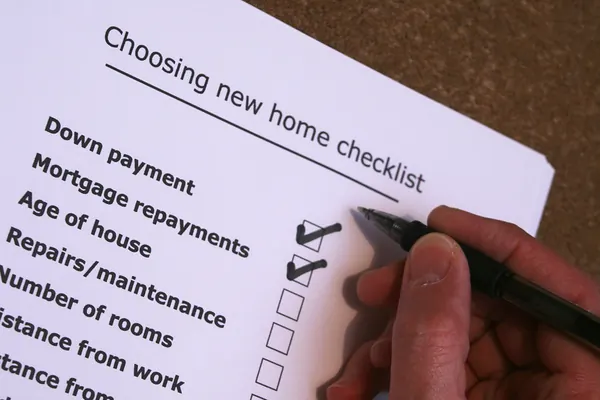



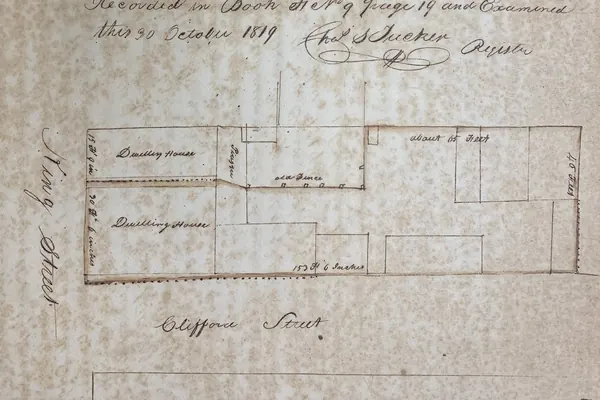

Illustrative photos, published by their authors under free licenses. They do not show our team, our readers or any loan.
How the kit works
- Choose: the one-page program screen tells you which of FHA, VA, USDA and conventional you can use, then the side-by-side sheet prices them on the same home.
- Qualify: the qualification worksheets give your income, debt-to-income ratio and cash to close before a lender sees your file.
- Close: the shopping and closing workbook runs from your first application to the keys, with every TRID deadline.
Free preview: The FHA, VA and USDA Loan Program Workbook (2026)
Three federal programs let you buy a home with little or no down payment: FHA loans, insured by the Federal Housing Administration (HUD); VA loans, guaranteed by the Department of Veterans Affairs; and USDA guaranteed loans, backed by the Rural Development agency of the Department of Agriculture. Each has its own gate (credit, service, location or income), its own fee and its own paperwork. Choosing the wrong one costs either a refusal late in the process or thousands of dollars in fees you could have avoided. This workbook lets you run the three sets of rules on your own file first, on paper, and compare them line by line with a conventional loan.
How to use it: print it (Ctrl+P or Cmd+P, then "Save as PDF" or print on paper) and fill it in with a pencil and a calculator. Chapter 1 is a one-page screen that tells you which chapters to fill in; chapters 2 to 4 are one program each; chapter 5 compares the costs; chapters 6 to 8 cover flood insurance, documents and the questions to ask lenders.
The rules quoted are those in force on October 12, 2026: HUD Single Family Housing Policy Handbook 4000.1 and Mortgagee Letters 2023-05 (premiums) and 2025-23 (2026 loan limits), the VA Lender's Handbook (M26-7) and VA.gov, and USDA regulations at 7 CFR part 3555 with Handbook HB-1-3555. Section numbers are given so you can read the official text.
Chapter 1: The program screen in one page
Answer the four gate questions first. A program whose gate you do not pass is out, whatever its price; a program whose gate you pass goes to the cost comparison in chapter 5.
Step 1: the gates
| Gate question | If yes | Your answer |
|---|---|---|
| Did you serve (active duty, Guard or Reserve) long enough for a VA Certificate of Eligibility, or are you a surviving spouse receiving Dependency and Indemnity Compensation? | VA is open: fill in chapter 3 | |
| Is the property in a USDA-eligible area on the USDA eligibility map, and is your household's adjusted income at or below the moderate income limit for that county and household size? | USDA is open: fill in chapter 4 | |
| Is your middle credit score 500 or higher, and will you live in the home as your primary residence? | FHA is open: fill in chapter 2 | |
| Is your middle credit score 620 or higher (the floor most lenders apply), with 3% to 5% down available? | Conventional is open: see the Conventional Loan Qualification Workbook |
All three government programs require the home to be your primary residence. None of them finances a vacation home or a rental you will not live in (a 2 to 4 unit property where you live in one unit is allowed by FHA and VA).
Step 2: the quick decision tree
- Eligible for VA? It is usually the cheapest of the four for a buyer with less than 20% down: no down payment, no monthly mortgage insurance, and the funding fee is waived for veterans receiving disability compensation. Compare it anyway in chapter 5 if you have 10% or more down.
- Not VA, but USDA-eligible property and income? USDA usually beats FHA: no down payment, a 1% upfront fee instead of 1.75%, and a 0.35% annual fee instead of 0.50% to 0.55%.
- Neither, a modest credit score and less than 10% down? FHA is often the realistic option: lenient on credit and on waiting periods after a bankruptcy.
- A strong credit score and 5% or more down? Price a conventional loan too: private mortgage insurance can cost less than FHA's premium and it ends, while FHA's premium lasts the life of the loan with less than 10% down.
Step 3: your shortlist
| Program | Gate passed? | Down payment you would make | Chapter to fill in |
|---|---|---|---|
| VA | 3 | ||
| USDA | 4 | ||
| FHA | 2 | ||
| Conventional | Qualification workbook |
Checkout by Stripe
Pay by card on Stripe’s secure page. Your card details never reach our servers.
Instant access
Your kit opens right after payment, to bookmark, print or save as a PDF. A payment receipt is emailed to you.
One price, paid once
The price shown is the total in US dollars. No subscription, nothing charged later. Refund policy.
Sources you can check
An information publisher, not a lender, broker or advisor; not legal or financial advice. Terms of sale.
Frequently asked questions
What is in the kit that I cannot buy separately?
The FHA, VA and USDA Loan Program Workbook (8 chapters) is sold only in this kit. The two other workbooks are also sold on their own (Conventional Loan Qualification Workbook $14, Mortgage Shopping & Closing Workbook $12).
How do I receive the workbook?
Right after payment you are taken to your workbook page. Bookmark it: the link stays valid and always shows the latest version. To keep a copy, print it or save it as a PDF from your browser (Ctrl+P or Cmd+P, then “Save as PDF”). Your invoice is emailed to you.
Is the payment secure, and is it a subscription?
You pay once on Stripe’s secure checkout page, by card or Apple Pay; your card details go to Stripe and never reach us. There is no subscription and nothing is charged later.
What is the difference with the free state guide?
The free PDF guide explains the rules and programs in your state. The kit is the working copy: worksheets, checklists, templates and comparison tables you fill in for your own loan. You can have both; the free guide stays free.
Who publishes the workbook?
Claude Loan, an information publisher: not a lender, broker, law firm or advisor, with no NMLS license. The kit quotes the official rules with their section numbers so you can check them; your lender and, if needed, a HUD-approved housing counselor or an attorney give the answers that apply to you.
What is the guarantee?
The kit is guaranteed as described: if it does not open or contains an error, we fix it, and if we cannot, we refund you in full. Bought the wrong title by mistake? Write within 7 days and we switch it. A duplicate payment is always refunded. See the refund policy in the terms of sale.
$49 is the total you pay: no tax or fee is added at checkout. Payment by Stripe (card or Apple Pay), instant access after payment. Terms of sale and refund policy. Claude Loan is an information publisher, not a lender or advisor; the kit is not legal or financial advice.