Manual underwriting: when a human decides your mortgage, and the ratios they use
Complete home loan kit, $49The Complete Home Loan Kit: FHA, VA, USDA and ConventionalFHA, VA, USDA and conventional: choose, qualify, close, 3 workbooks, instant access
See what is inside, $49Other titles: All workbooks

Manual underwriting means a human underwriter decides your mortgage on the program’s written rules instead of relying on an automated approval. It happens when the automated system returns a “Refer,” when the file has facts the system cannot weigh (a recent bankruptcy, disputed collections, no credit score), or when the program requires it. It is not a denial: on an FHA loan, manual underwriting allows debt-to-income ratios from 31/43 up to 40/50 with documented compensating factors, and Fannie Mae allows a total ratio of 36%, up to 45% with strong credit and reserves.
Why a file goes to manual underwriting
Each program runs applications through its automated engine first — Desktop Underwriter for Fannie Mae, Loan Product Advisor for Freddie Mac, the TOTAL Mortgage Scorecard for FHA, the Guaranteed Underwriting System for USDA. An “Approve/Accept” lets the lender follow the engine’s findings. A “Refer” or a downgrade sends the file to a person. On an FHA loan, HUD Handbook 4000.1 requires a downgrade to manual underwriting, even after an Accept, when for example:
- the borrower has $1,000 or more in disputed derogatory accounts (disputed medical accounts and identity-theft accounts excluded);
- a bankruptcy discharge is less than two years old, or a foreclosure, short sale or deed-in-lieu is less than three years old, at case number assignment;
- the mortgage history in the last 12 months shows three or more payments more than 30 days late, a 60-day late plus a 30-day late, or a payment more than 90 days late (purchase and no-cash-out refinance);
- the file contains information the scorecard cannot evaluate.
On an FHA loan, a borrower with no credit score is underwritten manually, with a credit history built from nontraditional sources such as rent and utility records (HUD Handbook 4000.1, II.A.5).
FHA manual underwriting ratios
HUD sets the maximum ratios as two numbers: housing payment to income, then total debt to income.
| Credit score | Maximum ratios | Compensating factors required |
|---|---|---|
| 500–579, or no credit score | 31/43 | None accepted to go higher (33/45 for an energy-efficient home) |
| 580 and above | 31/43 | None (33/45 for an energy-efficient home) |
| 580 and above | 37/47 | One: verified cash reserves, minimal increase in housing payment, or residual income |
| 580 and above | 40/40 | No discretionary debt |
| 580 and above | 40/50 | Two: reserves, minimal payment increase, significant additional income, residual income |
With no credit score, only the income of borrowers who will live in the home counts; a non-occupant co-borrower cannot add income. Separately, a score between 500 and 579 limits an FHA purchase to 90% loan-to-value — at least 10% down — whatever the underwriting route.
What each compensating factor means on FHA
- Cash reserves: at least three total monthly mortgage payments left after closing for one or two units (six for three or four units), not counting gifts, borrowed funds or the cash needed to close. See mortgage reserves.
- Minimal increase in housing payment: the new payment is no more than $100 or 5% above your current rent or mortgage, whichever is less, with a 12-month housing history showing no more than one 30-day late payment.
- No discretionary debt: the housing payment is your only open account carrying a balance; other accounts, open at least six months, are paid in full every month.
- Significant additional income: overtime, bonus, part-time or seasonal income received for at least a year but not counted, which would bring the ratios down to 37/47; it can only be used together with another factor.
- Residual income: money left each month after all obligations, measured against VA’s residual income tables.

Manual underwriting on VA, USDA and conventional loans
| Program | Manual underwriting standard | Source |
|---|---|---|
| VA | Total debt ratio of 41% as a guideline plus a residual income test; above 41%, approval needs a written justification by the underwriter’s supervisor, unless residual income beats the guideline by at least 20% | 38 CFR 36.4340(c) |
| USDA guaranteed | Ratio guidelines in the regulation (29% housing, 41% total debt, which compensating factors can exceed) refined by USDA’s technical handbook; files that GUS refers are underwritten against them by hand | 7 CFR 3555.151(h), HB-1-3555 chapter 11 |
| Conventional (Fannie Mae) | Minimum credit score of 620 on a fixed-rate loan and 640 on an ARM (Desktop Underwriter files have no fixed minimum); maximum total DTI of 36% of stable income, up to 45% when the borrower meets the credit score and reserve requirements in Fannie Mae’s Eligibility Matrix, against up to 50% through Desktop Underwriter | Selling Guide B3-5.1-01, B3-6-02 |
The USDA regulation’s ratios are summarized in our USDA loan requirements guide, together with the handbook’s current housing-ratio guideline.
How to prepare a file for a human underwriter
- Document 12 months of rent with canceled checks, bank statements or a landlord verification. It proves the housing history and can support the “minimal increase” factor.
- Write letters of explanation for every late payment, collection, gap in employment or large deposit, with dates and documents.
- Keep the cash. Reserves are the most widely accepted compensating factor; do not drain savings into a bigger down payment if it pushes reserves under three payments.
- Pay down revolving balances rather than closing accounts: “no discretionary debt” needs accounts that are open and paid in full monthly.
- Ask the lender up front whether it manually underwrites at all. Some lenders only close files with an automated approval; others accept manual files for FHA or VA but not conventional loans.
A complete paper file is what decides a manual approval, so the mortgage documents checklist is the place to start.
Frequently asked questions
What is manual underwriting for a mortgage?
A human underwriter reviews your credit, income, assets and debts against the program’s written rules and decides on the loan, instead of an automated system. It applies when the automated system refers the file, when the file contains facts the system cannot evaluate, or, on an FHA loan, when the borrower has no credit score.
What is the maximum DTI for FHA manual underwriting?
31/43 with no compensating factors; 37/47 with one; 40/40 with no discretionary debt; and 40/50 with two compensating factors. Borrowers with a score below 580 or no score stay at 31/43.
Is manual underwriting harder to pass?
The limits are tighter than an automated approval and every claim has to be documented, but a well-documented file within the ratios can be approved. It usually takes longer, because each condition is checked by hand.
Can I get an FHA loan with a 500 credit score?
FHA’s floor is 500. Between 500 and 579, the loan is limited to 90% loan-to-value (10% down), and if the file is manually underwritten the ratios cannot exceed 31/43. Many lenders set higher floors of their own.
Does Fannie Mae allow manual underwriting?
Yes. The maximum total debt-to-income ratio is 36% of stable monthly income, which can go to 45% when the borrower meets the credit score and reserve requirements of Fannie Mae’s Eligibility Matrix.
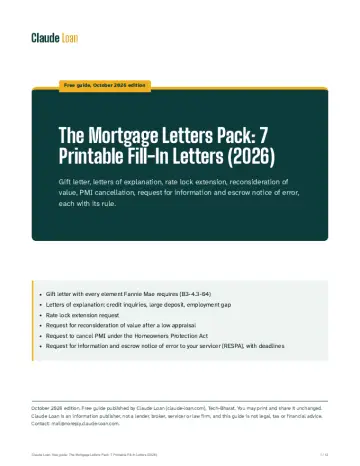
Free 12-page PDF
Free: Mortgage Letters Pack (gift, explanation, ROV, PMI)
Buyers and homeowners asked to write a letter by their lender, or who need to put a request to their servicer in writing.
Get the free PDFSources
- HUD Handbook 4000.1, II.A.4 (TOTAL downgrades) and II.A.5 (manual underwriting, ratios, compensating factors), PDF
- Fannie Mae Selling Guide B3-6-02 — Debt-to-income ratios
- Fannie Mae Selling Guide B3-5.1-01 — Minimum credit scores (manual underwriting)
- eCFR — 38 CFR 36.4340, VA underwriting standards (debt ratio, residual income)
- eCFR — 7 CFR 3555.151, USDA guaranteed loan eligibility and repayment ratios
Related: Debt-to-income ratio limits by loan type — and how to lower yours, USDA vs VA loan: which is better, and how both compare with FHA and conventional, Conventional loan requirements in 2026: what Fannie Mae’s guide actually says. Hub: First-time buyer.