The Low Appraisal and Appraisal Gap Playbook (2026)
What to do when the value comes in below the price: read the report like an underwriter, use your rights, file a reconsideration of value that gets read, and close the gap with numbers instead of panic
Guaranteed as described, or refunded in full, and the wrong title switched within 7 days. Refund policy
For $80 more: The Claude Loan Library: Every Workbook and Ebook, 16 titles, $6.19 per title.
Secure checkout by Stripe (card or Apple Pay). Refund policy
Questions: mail@noreply.claude-loan.com
- 10chapters
- 47checklist items
- 17tables
- 17links to official sources
Checked before every release
Every rule is cited by section to an official source you can open (how titles are checked, corrections)
- 68automated testsrun at every release: prices, links, pages and data checked before publication.
- 17official sources linkedevery rule quoted with its section (CFPB, HUD, Fannie Mae) so you can check it.
- October 23, 2026editiondate of the current edition; rules and annual limits are updated when they change, and corrections are dated.
Built from the rules and data of HUD, CFPB, Fannie Mae, Appraisal Subcommittee, Freddie Mac, VA.
Who it is for
- Buyers whose appraisal came in below the contract price, or who fear it will in a competitive market
- Buyers about to sign a purchase contract who want an appraisal contingency or an appraisal gap clause they actually understand
- Homeowners whose refinance or PMI removal depends on a value that came in lower than expected
What it is not: it is not an appraisal or a broker price opinion: only a licensed or certified appraiser can give an opinion of market value; it is not legal advice on your purchase contract or on a discrimination claim: a real estate attorney or a HUD-approved housing counselor is the right help for that.
In pictures



Illustrative photos, published by their authors under free licenses. They do not show our team, our readers or any loan.
Free guides, this ebook or the library
Our free guides explain the rules. The paid titles are the working copies: worksheets and checklists you fill in for your own loan, each citing the official rule.
Free guides
$0
our articles and your free state guide (PDF)
- ✓The rules explained, official sources cited
- —Worksheets you fill in for your own loan
- —47 checklist items
- —17 worksheets and reference tables
- —28-page PDF to print, plus an online copy
- —All 13 ebooks and the complete home loan kit
Low appraisal ebook
$19
paid once
- ✓The rules explained, official sources cited
- ✓Worksheets you fill in for your own loan
- ✓47 checklist items
- ✓17 worksheets and reference tables
- ✓28-page PDF to print, plus an online copy
- —All 13 ebooks and the complete home loan kit
The Claude Loan Library: Every Workbook and Ebook
$99
16 titles; $431 bought one by one
- ✓The rules explained, official sources cited
- ✓Worksheets you fill in for your own loan
- ✓47 checklist items
- ✓17 worksheets and reference tables
- ✓28-page PDF to print, plus an online copy
- ✓All 13 ebooks and the complete home loan kit
Guaranteed as described, or refunded in full
What is inside
- The day the value comes in low: what it changes and your four paths free below
- How an appraiser reaches the number
- Your rights as a borrower
- When there is no appraisal: value acceptance, property data and ACE
- Before you sign: the contract decides your options
- The reconsideration of value, step by step
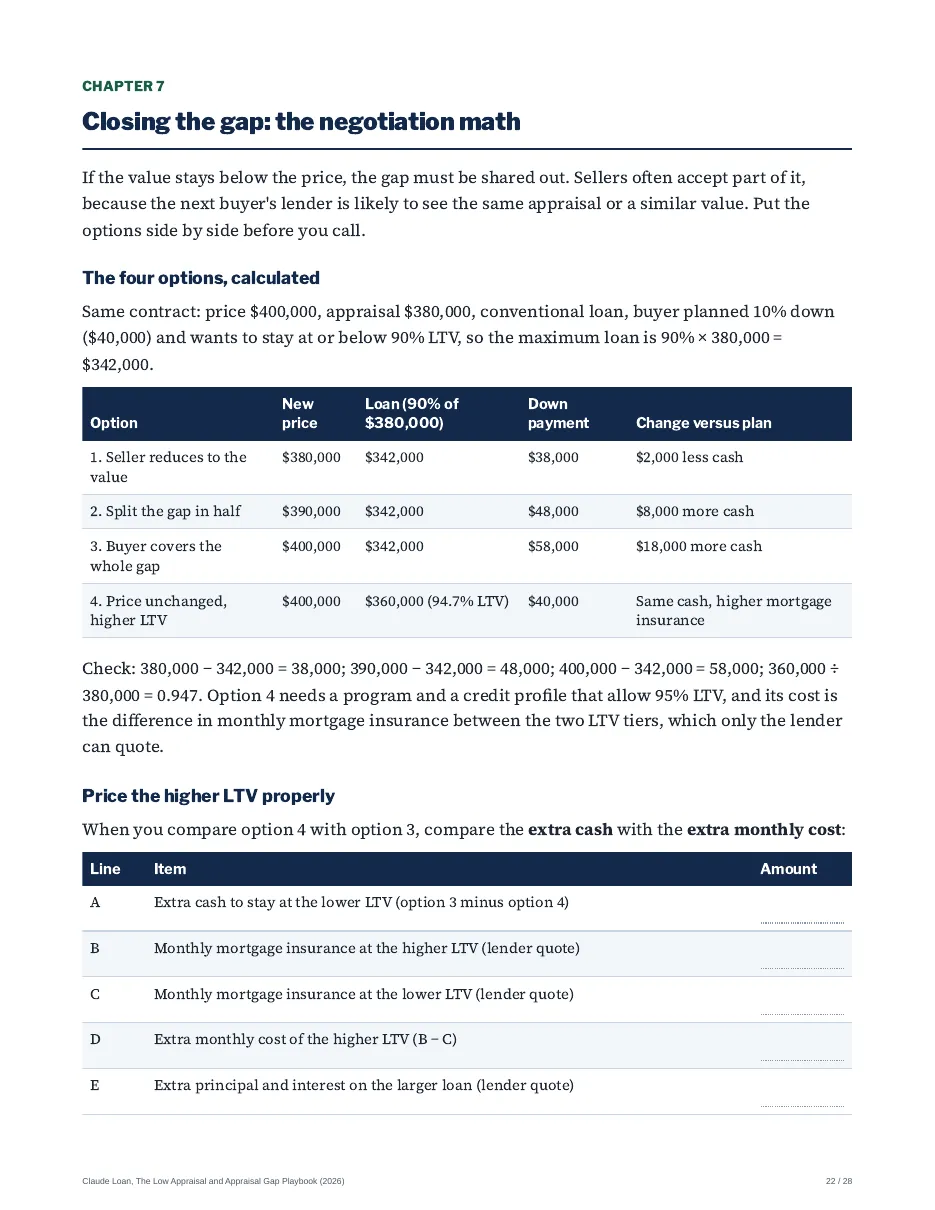
- Closing the gap: the negotiation math
- Second appraisals, transferred appraisals and changing lenders
- A low value on a refinance or a PMI request
- When the value may be biased or the appraisal broke the rules
- Sources
Included in the paid chapters: 40 checklist items and 15 worksheets or reference tables, each citing the official rule it relies on.
Introduction
An appraisal is one licensed professional's opinion of what your home would sell for on a given date. It takes a few days to produce, it costs a few hundred dollars, and it can rewrite the most important number of your purchase: the loan amount. When the value comes in below the contract price, the lender does not lend on the price you agreed. It lends on the lower figure, and the difference, the appraisal gap, has to be solved before closing by someone: you, the seller, or both.
Most buyers meet this problem with two days of notice and no method. This playbook gives you the method. It shows how the value is actually built, how to read the report the way an underwriter does, what federal law and the loan programs give you as a borrower (a free copy of every valuation, an appraiser who cannot be pressured, and since 2024 a formal reconsideration of value process at Fannie Mae and Freddie Mac), and how to close a gap with numbers: renegotiating, splitting, adding cash or changing the loan, each one calculated.
How to use it: read chapter 1 the day the appraisal is ordered, not the day it arrives; chapter 2 explains the report; chapter 3 lists your rights; chapter 4 covers loans with no appraisal at all; chapter 5 is about the contract, before you sign; chapter 6 is the reconsideration of value, step by step with a letter; chapter 7 is the negotiation math; chapter 8 covers second appraisals and changing lenders; chapter 9 is for refinances; chapter 10 is about bias and misconduct complaints.
The rules quoted are those in force in October 2026: Regulation B (12 CFR 1002.14, the copy of valuations), Regulation Z (12 CFR 1026.42 on valuation independence and 12 CFR 1026.35(c) on appraisals for higher-priced loans), the interagency guidance on reconsiderations of value issued by the CFPB, FDIC, Federal Reserve, NCUA and OCC in July 2024, and the Fannie Mae Selling Guide (B4-1.1-04, B4-1.3-12, B4-1.4-10 and B4-1.4-11). Section numbers are given so you can read the official text.
Chapter 1: The day the value comes in low: what it changes and your four paths
A low appraisal is not a loan denial. It is a change in one input of the loan, and every other input moves with it. Before you call anyone, understand which number changed and why.
The rule that creates the gap
On a purchase, lenders compute the loan-to-value ratio (LTV) on the lower of the purchase price and the appraised value. Every limit of your loan is tied to that ratio: the maximum loan amount, the minimum down payment, whether you pay mortgage insurance, and at which price tier.
| Item | If the appraisal equals the price | If the appraisal is lower |
|---|---|---|
| Value used for the LTV | Purchase price | Appraised value |
| Maximum loan | Program maximum LTV × price | Program maximum LTV × appraised value |
| Your down payment | Price − loan | Price − loan, so it grows if the loan shrinks |
| Mortgage insurance | Priced on the LTV of the price | Priced on a higher LTV, often a more expensive tier |
Worked example: the same gap, three buyers
A contract at $400,000 appraises at $380,000. The appraisal gap is $20,000.
Buyer A, conventional, planned 10% down. The plan was a $360,000 loan and $40,000 down. On the appraised value, a $360,000 loan is an LTV of 360,000 ÷ 380,000 = 94.7%. If the program and the borrower qualify up to 95%, the loan can stay at $360,000 and the cash needed does not change, but the mortgage insurance is now priced at about 95% LTV instead of 90%. To stay at 90% LTV, the loan must fall to 90% × 380,000 = $342,000, and the down payment rises to 400,000 − 342,000 = $58,000, which is $18,000 more than planned.
Buyer B, FHA, maximum financing. FHA's base maximum is 96.5% LTV. On the price, that was 96.5% × 400,000 = $386,000 loan and $14,000 down. On the appraised value, the maximum is 96.5% × 380,000 = $366,700, so the down payment becomes 400,000 − 366,700 = $33,300, or $19,300 more than planned.
Buyer C, 20% down conventional. The plan: a $320,000 loan and $80,000 down. On the appraised value, 320,000 ÷ 380,000 = 84.2% LTV: above 80%, so mortgage insurance appears where there was none. Keeping 80% LTV means a loan of 80% × 380,000 = $304,000 and $96,000 down, $16,000 more.
The lesson: a $20,000 gap is not always $20,000 of new cash. Depending on your program and your margin, it may cost you nothing upfront but a higher mortgage insurance premium, or it may cost almost the full gap. Do the calculation for your own loan before you negotiate (worksheet below).
The four paths
- Challenge the value with a reconsideration of value (chapter 6) when the report contains errors or missed better comparable sales.
- Renegotiate the price with the seller, down to the value or part of the way (chapter 7).
- Absorb the gap with more cash or a higher LTV, if you can and it still makes sense (chapter 7).
- Walk away under your appraisal contingency, or under the FHA or VA amendatory clause, if the contract gives you that right (chapter 5).
These paths are not exclusive. The common sequence is: request a reconsideration of value at once, open the conversation with the seller in parallel, and keep the cash option calculated in your pocket.
Worksheet: what the gap means for my loan
| Line | Item | Amount |
|---|---|---|
| A | Contract price | |
| B | Appraised value | |
| C | Appraisal gap (A − B) | |
| D | Loan amount you planned | |
| E | New LTV if the loan stays the same (D ÷ B) | |
| F | Maximum LTV of your program and credit profile (ask the lender) | |
| G | Maximum loan on the appraised value (F × B) | |
| H | Down payment needed if you borrow the maximum (A − G) | |
| I | Down payment you planned (A − D) | |
| J | Extra cash needed at the maximum loan (H − I, zero if negative) | |
| K | Mortgage insurance monthly cost at the new LTV (ask the lender for a new Loan Estimate or a written quote) | |
| L | Days left in your appraisal contingency |
The first 48 hours
- Get the full appraisal report, not just the value: you have a right to a copy (chapter 3)
- Write down the dates in your contract: appraisal contingency deadline, financing contingency deadline, closing date
- Complete the worksheet above with your loan officer on the phone
- Read the report with the chapter 2 checklist and list factual errors
- Ask your agent for closed sales the appraiser did not use (chapter 6 worksheet)
- Ask the lender, in writing, how its reconsideration of value process works and how long it takes
- Do not sign an amendment, waive a contingency or let a deadline pass before you have done the above
Checkout by Stripe
Pay by card on Stripe’s secure page. Your card details never reach our servers.
Instant access
Your ebook opens right after payment, to bookmark, print or save as a PDF. A payment receipt is emailed to you.
One price, paid once
The price shown is the total in US dollars. No subscription, nothing charged later. Refund policy.
Sources you can check
17 links to official sources (CFPB, HUD, Fannie Mae, Freddie Mac). An information publisher, not a lender, broker or advisor; not legal or financial advice. Terms of sale.
Frequently asked questions
What exactly do I receive?
Right after payment you land on your ebook page: the full text online, and a button to download the PDF (28 pages, US Letter, printable). Bookmark the page: the link stays valid and always shows the latest version. Your invoice is emailed to you.
Is it up to date for 2026?
Yes. Every rule is quoted as in force in October 2026, with its section number (CFR, HUD, FEMA, Fannie Mae or state rule) so you can check it yourself. When a rule or an annual limit changes, we update the online copy and the PDF.
Is the payment secure, and is it a subscription?
You pay once on Stripe’s secure checkout, by card or Apple Pay; your card details go to Stripe and never reach us. There is no subscription and nothing is charged later.
Who publishes the ebook?
Claude Loan, an information publisher: not a lender, broker, insurance agent, law firm or advisor, with no NMLS license. The ebook explains the official rules and gives you worksheets; your lender, insurance agent, a HUD-approved housing counselor or an attorney give the answers that apply to you.
What is the guarantee?
The ebook is guaranteed as described: if it does not open or contains an error, we fix it, and if we cannot, we refund you in full. Bought the wrong title by mistake? Write within 7 days and we switch it. A duplicate payment is always refunded. See the refund policy in the terms of sale.
Our other ebooks
Flood insurance ebook
The Flood Insurance Workbook for Home Buyers and Condo Owners (2026)
What your lender must require, what an NFIP or private policy really pays, the condo RCBAP gaps, and how to lower the premium before you sign.
$19 9 chapters, 28-page PDF + online copy
Title insurance ebook
The Owner's Title Insurance Guide for Home Buyers (2026)
Decide on the owner’s policy with real numbers: state rates, the Loan Estimate math, who pays, the commitment line by line, endorsements and claims.
$19 8 chapters, 22-page PDF + online copy
Construction loan ebook
The Construction and Renovation Loan Workbook (2026)
One-time or two-time close, FHA 203(k) 2026 rules, HomeStyle, USDA combination loans, then budgets, builder checks, draw schedules and conversion.
$24 10 chapters, 27-page PDF + online copy
Reverse mortgage ebook
The Reverse Mortgage (HECM) Decision Workbook (2026)
The 2026 HECM limit, every fee, payout choices, the rules that protect a spouse and heirs, counseling preparation and the alternatives, priced.
$24 10 chapters, 24-page PDF + online copy
Compliance study guide
The Mortgage Compliance Study Guide (2026): ECOA, TRID, RESPA, SAFE Act and More
One-page rule summaries with the 2026 thresholds and more than 100 original practice questions, each answered with the exact CFR section.
$39 10 chapters, 32-page PDF + online copy
Self-employed ebook
The Self-Employed Mortgage Income Workbook (2026)
Run the Form 1084 cash flow on your own returns: Schedule C, K-1s, S corps, the liquidity test, under two years, declining income and business funds.
$24 11 chapters, 34-page PDF + online copy
SCRA ebook
The SCRA and Military Homeowner Workbook (2026)
Claim the 6% cap, stop a foreclosure without a court order, end a lease on orders, then keep, rent or sell the house after a PCS, with letters and trackers.
$19 10 chapters, 31-page PDF + online copy
Jumbo loan ebook
The Jumbo and High-Balance Loan Workbook (2026)
Find your county’s 2026 limit, see what changes between standard, high-balance and jumbo loans, and price staying under the line with your own numbers.
$29 8 chapters, 28-page PDF + online copy
LO compensation handbook
The Loan Originator Compensation and Conduct Handbook (12 CFR 1026.36, 2026)
Audit a pay plan against 12 CFR 1026.36: lender-paid or borrower-paid, the proxy test, the 10% bonus limit, the steering safe harbor, NMLS IDs and records.
$49 10 chapters, 41-page PDF + online copy
Flood compliance toolkit
The Flood Compliance Toolkit for Lenders and Loan Staff (12 CFR 339, 2026)
Test a flood file against 12 CFR 339 and the 2022 Interagency Q&As: triggers, the determination, exemptions, the minimum amount, deductibles, escrow, notices, private flood and force placement.
$39 9 chapters, 35-page PDF + online copy
Condo buyer ebook
The Condo Buyer's Mortgage Workbook: Project Approval, HOA Questionnaire and Insurance
Know before the appraisal whether the building can be financed: the 2026 project review rules, the HOA questionnaire line by line, FHA and VA approval, HO-6, assessments and the true monthly cost.
$29 9 chapters, 41-page PDF + online copy
ECOA adverse action toolkit
The ECOA and Regulation B Adverse Action Toolkit for Mortgage Lenders (2026)
Send the right Regulation B notice on time with the real reasons: applications, the 30-day clock, Appendix C forms, counteroffers, the valuations rule, age and income, 25-month records.
$49 10 chapters, 50-page PDF + online copy
Free guides on the same topic
- Appraisal waivers: how value acceptance and ACE decide you skip the appraisal
- Appraisal gap: what happens when the home appraises below your offer
$19 is the total you pay: no tax or fee is added at checkout. Payment by Stripe (card or Apple Pay), instant access after payment. Terms of sale and refund policy. Claude Loan is an information publisher, not a lender or advisor; the ebook is not legal or financial advice.