The Owner's Title Insurance Guide for Home Buyers (2026)
Decide whether you need an owner's policy, price it to the dollar, read the title commitment line by line and know what to do if a claim ever comes
Guaranteed as described, or refunded in full, and the wrong title switched within 7 days. Refund policy
For $80 more: The Claude Loan Library: Every Workbook and Ebook, 16 titles, $6.19 per title.
Secure checkout by Stripe (card or Apple Pay). Refund policy
Questions: mail@noreply.claude-loan.com
- 8chapters
- 2letter templates
- 31checklist items
- 13tables
Checked before every release
Every rule is cited by section to an official source you can open (how titles are checked, corrections)
- 68automated testsrun at every release: prices, links, pages and data checked before publication.
- ✓Rules cited by sectionevery rule quoted with its section (HUD, CFPB) so you can check it.
- October 21, 2026editiondate of the current edition; rules and annual limits are updated when they change, and corrections are dated.
Built from the rules and data of HUD, CFPB.
Who it is for
- Home buyers who see 'Title – Owner's Title Policy (optional)' on their Loan Estimate and want to decide with real numbers
- Buyers of a foreclosure, an estate sale, a for-sale-by-owner home, new construction or a home bought for cash
- Owners who want to understand the policy they already have, or who found a title problem after closing
What it is not: it is not legal advice on a specific title defect: a real estate attorney in your state reads your documents; it does not recommend a title company or an underwriter, and we receive nothing from any of them.
In pictures
Illustrative photos, published by their authors under free licenses. They do not show our team, our readers or any loan.
Free guides, this ebook or the library
Our free guides explain the rules. The paid titles are the working copies: worksheets and checklists you fill in for your own loan, each citing the official rule.
Free guides
$0
our articles and your free state guide (PDF)
- ✓The rules explained, official sources cited
- —Worksheets you fill in for your own loan
- —31 checklist items
- —13 worksheets and reference tables
- —22-page PDF to print, plus an online copy
- —All 13 ebooks and the complete home loan kit
Title insurance ebook
$19
paid once
- ✓The rules explained, official sources cited
- ✓Worksheets you fill in for your own loan
- ✓31 checklist items
- ✓13 worksheets and reference tables
- ✓22-page PDF to print, plus an online copy
- —All 13 ebooks and the complete home loan kit
The Claude Loan Library: Every Workbook and Ebook
$99
16 titles; $431 bought one by one
- ✓The rules explained, official sources cited
- ✓Worksheets you fill in for your own loan
- ✓31 checklist items
- ✓13 worksheets and reference tables
- ✓22-page PDF to print, plus an online copy
- ✓All 13 ebooks and the complete home loan kit
Guaranteed as described, or refunded in full
What is inside
- What title insurance covers, what it never covers, and whether you need it free below
- How the premium is set in your state
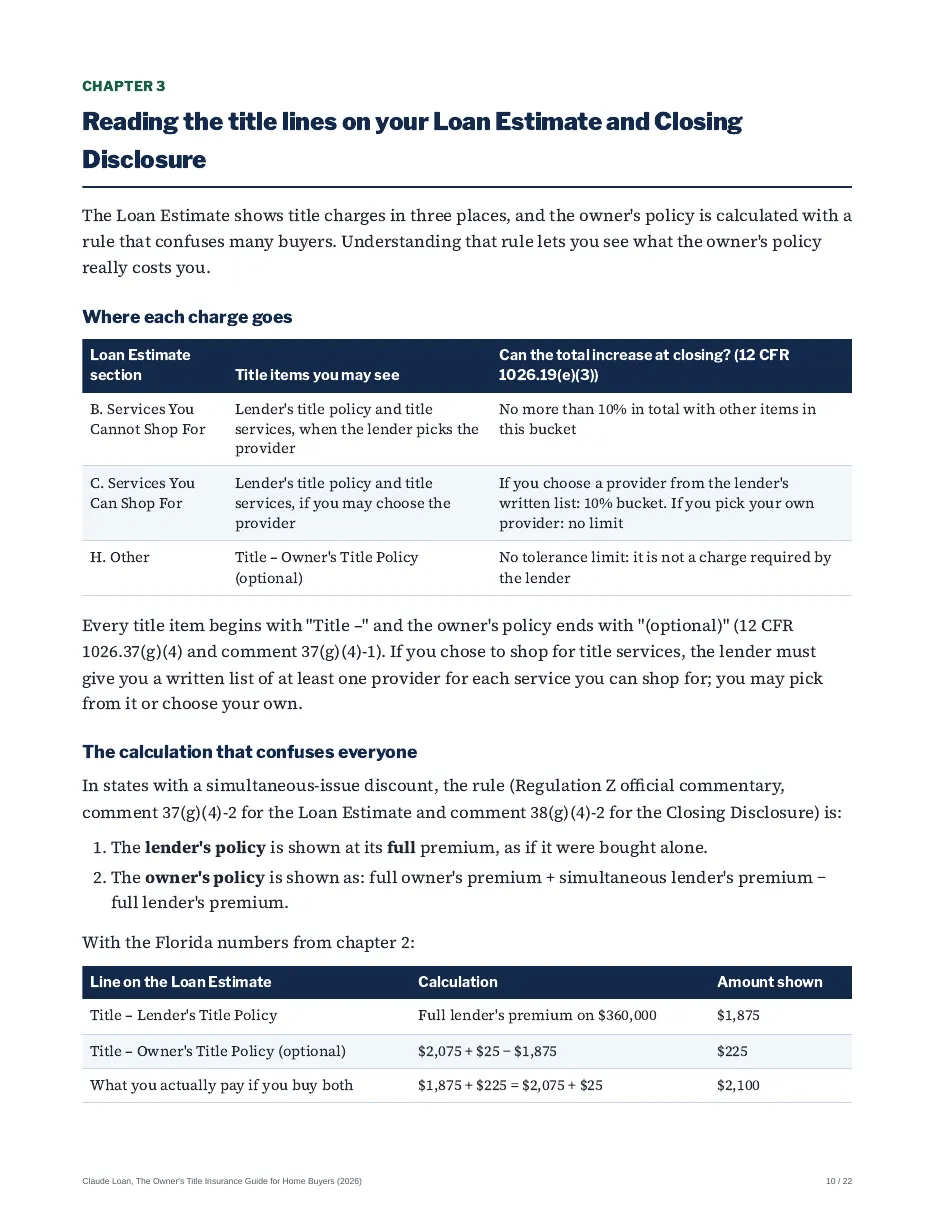
- Reading the title lines on your Loan Estimate and Closing Disclosure
- Who pays, who chooses, and your rights under RESPA
- The title commitment: requirements and exceptions, line by line
- Policy forms and endorsements that matter to a home buyer
- Special situations: new construction, foreclosures, sales by owner, cash and condos
- Closing day and afterwards: wire fraud, the final policy and claims
Included in the paid chapters: 31 checklist items and 10 worksheets or reference tables, each citing the official rule it relies on.
Introduction
Every home purchase with a mortgage includes title insurance, because the lender requires a lender's policy that protects its loan. A second policy, the owner's policy, protects you, and on the Loan Estimate it carries the word "(optional)". The decision usually takes ten seconds at the closing table, with a number that is hard to interpret and a title company that is also the one selling the policy.
This guide gives you the information that is missing in that moment. It explains what an owner's policy covers and what it never covers, how the premium is set in your state, why the number on your Loan Estimate is calculated the way it is, who customarily pays, how to read the title commitment and its list of exceptions, which endorsements matter for a home buyer, and how a claim works. Each chapter ends with a worksheet or a checklist.
How to use it: read chapter 1 before you sign the purchase contract (who pays title insurance is often negotiated there); chapters 2 to 4 when you receive the Loan Estimate; chapters 5 and 6 when the title commitment arrives, usually two to three weeks before closing; chapter 7 if your purchase is not a standard resale; chapter 8 for closing day and afterwards.
The rules quoted are those in force in October 2026: the Real Estate Settlement Procedures Act and Regulation X (12 U.S.C. 2601 and following; 12 CFR part 1024), Regulation Z's Loan Estimate and Closing Disclosure rules and their official commentary (12 CFR 1026.37 and 1026.38, Supplement I), and state title insurance rate rules, with Florida's rate rule (Florida Administrative Code 69O-186.003) used for the worked examples because its rates are set by rule and public. Title insurance is regulated by the states: where your state's rule differs, your state's rule applies.
Chapter 1: What title insurance covers, what it never covers, and whether you need it
Title insurance is unlike other insurance. You pay once, at closing, and the policy protects against problems that already existed on the day you bought: a forged signature years ago, an heir who never signed, a lien that was never released, a mistake in the public records. Your homeowners insurance looks forward; title insurance looks backward.
Two policies, two beneficiaries
| Lender's policy | Owner's policy | |
|---|---|---|
| Who it protects | The lender (and whoever later owns the loan) | You, and in most current forms your heirs and some transferees such as your own estate-planning trust |
| Amount of coverage | The loan amount, decreasing as the loan is paid down | Usually the purchase price |
| How long it lasts | Until the loan is paid off or refinanced | As long as you or your heirs own an interest in the home (or remain liable on warranties of title after you sell) |
| Required? | Yes, by virtually every mortgage lender | No: optional, which is why the Loan Estimate labels it "(optional)" |
| If a covered problem appears | Pays the lender up to its loss on the loan | Defends your title in court and pays covered losses up to the policy amount |
The Consumer Financial Protection Bureau puts it simply: the lender's policy protects only the lender; if you want protection for yourself, you buy an owner's policy (CFPB, "What is owner's title insurance?").
Typical covered risks
Owner's policy forms list their covered risks; the most common ones for a home buyer are:
- Someone else owns an interest in the title (for example an heir, a former spouse, a co-owner who never signed the deed)
- A document in the chain of title was forged, signed under a forged power of attorney, or signed by someone who lacked capacity
- A deed or other document was not properly signed, sealed, acknowledged, delivered or recorded
- An old mortgage, judgment, tax lien, mechanics' lien or HOA lien was never released
- Fraud, duress or impersonation in a past transfer
- Lack of a legal right of access to and from the land
- An error in the public records, or an incorrect legal description
What it never covers, even with an owner's policy
- Anything listed as an exception in Schedule B of the policy (chapter 5): easements, covenants, survey matters and other items the title company found or excluded. These are the most important pages of the policy.
- Problems you knew about and did not disclose to the title company, or that you created or agreed to.
- Problems that arise after the policy date, with limited exceptions in the enhanced homeowner's policy forms (chapter 6).
- Government police power: zoning, building codes and land-use rules, except to the extent a specific covered risk or endorsement says otherwise.
- Physical condition of the house: title insurance is not a home warranty and does not cover a bad roof or a failed septic system.
- Value: if the market falls, title insurance does not pay the difference.
Should you buy the owner's policy? A decision worksheet
Nobody can tell you that a title problem will or will not appear. What you can do is look at the factors that make one more likely, compare the price with the risk you would keep, and decide on paper. Mark each line that applies.
| Factor | Why it matters | Applies to me? |
|---|---|---|
| The seller is an estate, a trust, an heir or a court-appointed representative | Heirs and capacity issues are a classic source of claims | |
| The home was sold in the last 12 months (a flip) or changed hands by quitclaim deed | Quick transfers and quitclaims are where forgery and fraud hide | |
| Foreclosure, bank-owned (REO), tax sale or short sale | Notice defects in the foreclosure and junior liens can survive | |
| Sale by owner, without agents on either side | Fewer professionals checked the paperwork | |
| New construction or recent major renovation | Unpaid contractors can file mechanics' liens that relate back | |
| Rural land, shared driveway, private road, wells or easements | Access and easement disputes | |
| Condominium or HOA community | Unpaid assessments and association liens | |
| A divorce, bankruptcy or separation involving a past owner | Spousal rights and bankruptcy trustee claims | |
| You pay cash (no lender's policy at all) | Without an owner's policy, nobody insures the title | |
| You plan to keep the home 10 years or more | Longer exposure; the owner's policy lasts as long as you own |
Then fill in the price side (chapter 2 gives the method):
| Line | Item | Amount |
|---|---|---|
| A | Cost to you of adding the owner's policy (the extra premium, plus any endorsements) | |
| B | Purchase price you would be protecting | |
| C | Your equity at closing (down payment and closing costs paid) | |
| D | Lines checked in the factor table above | |
| E | Your decision and the reason, in one sentence |
Checkout by Stripe
Pay by card on Stripe’s secure page. Your card details never reach our servers.
Instant access
Your ebook opens right after payment, to bookmark, print or save as a PDF. A payment receipt is emailed to you.
One price, paid once
The price shown is the total in US dollars. No subscription, nothing charged later. Refund policy.
Sources you can check
4 links to official sources (HUD, CFPB). An information publisher, not a lender, broker or advisor; not legal or financial advice. Terms of sale.
Frequently asked questions
What exactly do I receive?
Right after payment you land on your ebook page: the full text online, and a button to download the PDF (22 pages, US Letter, printable). Bookmark the page: the link stays valid and always shows the latest version. Your invoice is emailed to you.
Is it up to date for 2026?
Yes. Every rule is quoted as in force in October 2026, with its section number (CFR, HUD, FEMA, Fannie Mae or state rule) so you can check it yourself. When a rule or an annual limit changes, we update the online copy and the PDF.
Is the payment secure, and is it a subscription?
You pay once on Stripe’s secure checkout, by card or Apple Pay; your card details go to Stripe and never reach us. There is no subscription and nothing is charged later.
Who publishes the ebook?
Claude Loan, an information publisher: not a lender, broker, insurance agent, law firm or advisor, with no NMLS license. The ebook explains the official rules and gives you worksheets; your lender, insurance agent, a HUD-approved housing counselor or an attorney give the answers that apply to you.
What is the guarantee?
The ebook is guaranteed as described: if it does not open or contains an error, we fix it, and if we cannot, we refund you in full. Bought the wrong title by mistake? Write within 7 days and we switch it. A duplicate payment is always refunded. See the refund policy in the terms of sale.
Our other ebooks
Flood insurance ebook
The Flood Insurance Workbook for Home Buyers and Condo Owners (2026)
What your lender must require, what an NFIP or private policy really pays, the condo RCBAP gaps, and how to lower the premium before you sign.
$19 9 chapters, 28-page PDF + online copy
Construction loan ebook
The Construction and Renovation Loan Workbook (2026)
One-time or two-time close, FHA 203(k) 2026 rules, HomeStyle, USDA combination loans, then budgets, builder checks, draw schedules and conversion.
$24 10 chapters, 27-page PDF + online copy
Reverse mortgage ebook
The Reverse Mortgage (HECM) Decision Workbook (2026)
The 2026 HECM limit, every fee, payout choices, the rules that protect a spouse and heirs, counseling preparation and the alternatives, priced.
$24 10 chapters, 24-page PDF + online copy
Compliance study guide
The Mortgage Compliance Study Guide (2026): ECOA, TRID, RESPA, SAFE Act and More
One-page rule summaries with the 2026 thresholds and more than 100 original practice questions, each answered with the exact CFR section.
$39 10 chapters, 32-page PDF + online copy
Self-employed ebook
The Self-Employed Mortgage Income Workbook (2026)
Run the Form 1084 cash flow on your own returns: Schedule C, K-1s, S corps, the liquidity test, under two years, declining income and business funds.
$24 11 chapters, 34-page PDF + online copy
SCRA ebook
The SCRA and Military Homeowner Workbook (2026)
Claim the 6% cap, stop a foreclosure without a court order, end a lease on orders, then keep, rent or sell the house after a PCS, with letters and trackers.
$19 10 chapters, 31-page PDF + online copy
Low appraisal ebook
The Low Appraisal and Appraisal Gap Playbook (2026)
Read the appraisal like an underwriter, file a reconsideration of value that gets read, and close an appraisal gap with numbers, not panic.
$19 10 chapters, 28-page PDF + online copy
Jumbo loan ebook
The Jumbo and High-Balance Loan Workbook (2026)
Find your county’s 2026 limit, see what changes between standard, high-balance and jumbo loans, and price staying under the line with your own numbers.
$29 8 chapters, 28-page PDF + online copy
LO compensation handbook
The Loan Originator Compensation and Conduct Handbook (12 CFR 1026.36, 2026)
Audit a pay plan against 12 CFR 1026.36: lender-paid or borrower-paid, the proxy test, the 10% bonus limit, the steering safe harbor, NMLS IDs and records.
$49 10 chapters, 41-page PDF + online copy
Flood compliance toolkit
The Flood Compliance Toolkit for Lenders and Loan Staff (12 CFR 339, 2026)
Test a flood file against 12 CFR 339 and the 2022 Interagency Q&As: triggers, the determination, exemptions, the minimum amount, deductibles, escrow, notices, private flood and force placement.
$39 9 chapters, 35-page PDF + online copy
Condo buyer ebook
The Condo Buyer's Mortgage Workbook: Project Approval, HOA Questionnaire and Insurance
Know before the appraisal whether the building can be financed: the 2026 project review rules, the HOA questionnaire line by line, FHA and VA approval, HO-6, assessments and the true monthly cost.
$29 9 chapters, 41-page PDF + online copy
ECOA adverse action toolkit
The ECOA and Regulation B Adverse Action Toolkit for Mortgage Lenders (2026)
Send the right Regulation B notice on time with the real reasons: applications, the 30-day clock, Appendix C forms, counteroffers, the valuations rule, age and income, 25-month records.
$49 10 chapters, 50-page PDF + online copy
Free guides on the same topic
$19 is the total you pay: no tax or fee is added at checkout. Payment by Stripe (card or Apple Pay), instant access after payment. Terms of sale and refund policy. Claude Loan is an information publisher, not a lender or advisor; the ebook is not legal or financial advice.